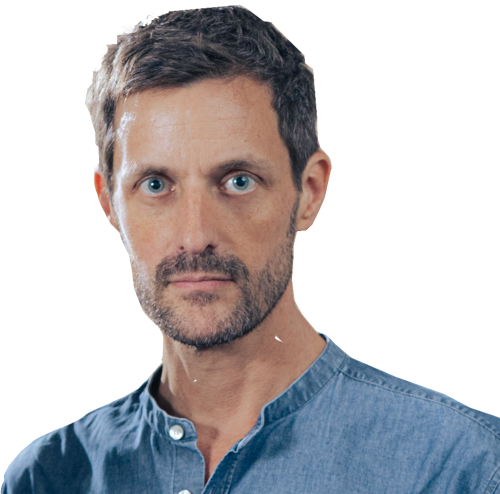
Matias Echanove is Swiss and Spanish urbanologist with over 20 years of research and practice in Asia, America and Europe. He lived, studied and worked in London, New York, Tokyo, and Mumbai, where he co-founded urbz, together with Rahul Srivastava and Geeta Mehta.
His academic training in government and economics at London School of Economics, urban planning at Columbia University, and urban information systems at the University of Tokyo, along with his personal and professional engagement with neighborhoods such as Bed-Stuy in Brooklyn NY, Shimokitazawa in Tokyo or Dharavi in Mumbai have largely contributed to shape urbz’ current practice.
Matias currently lives in his native city of Geneva, where he co-directs urbz Switzerland. He is also co-director at urbz Paris and an active partner at urbz’ offices in Mumbai and Bogota. He leads or coordinates projects in each of these countries, which involves spending too much time on Zoom calls and plane flights. Matias recently fell in love with the city of Cali in Colombia, where urbz works on the development of participatory tools and methodologies at the scale of the city. In Geneva, he works on the landscaping of a park for the International Federation of the Red Cross, among other projects. He is also currently involved in the reprogramming of a massive hospital complex in Nantes; and an improvement plan for a fisherman’s village in the heart of Mumbai.
Matias Echanove is regularly invited to present his work at institutions such as Harvard, Columbia, Berkeley, Princeton, ETHZ, EPFL, Strelka Institute, Max Planck Institute, the World Bank, the Swiss Architecture Museum in Basel, and Urban Age. He has written a large number of articles and opinion pieces in journals such as The New York Times, The Hindu, The Guardian, The Wall Street Journal, Art India, Oxford University Press, Strelka Press (Moscow), Domus (Milan), Tokyo University Press, and The Indian Architect and Builder. He was also interviewed on urban issues in the New York Times and The Economist. Together with Rahul Srivastava, he is currently writing a book on Homegrown Cities that will be published by Verso in 2026.
His work with urbz was exhibited at MoMA in New York, MAXXI in Rome, MAK in Vienna, Istanbul Design Biennial, Chicago Architecture Biennial, São Paulo Cultural Center, and Bhau Daji Lad City Museum in Mumbai, among other places.
Matias Echanove and Rahul Srivastava are Ambassador of Swiss-Indian friendship, an award given in 2017 by Swiss President Doris Leuthard and Indian Minister for Road Transport and Highways Mr. Mansukh L. Mandaviya for contributing innovative ideas in urban planning, and for strengthening the Swiss-Indian relationship.
Articles

The Homegrown Cities Initiative: Update
After a handstorm workshop to make a variety of user-oriented objects and with a pilot house on its way, a report about the updates of the Homegrown Cities Initiative


To Make Housing Affordable, Keep it Local
The official target of producing millions of quality homes for all can be re-imagined, as one in which the process of construction itself becomes a transformative moment.
Homegrown Things
Conceptualised by designers in collaboration with users and local artisans, the Handstorm workshop takes objects used in everyday life and gives them a spin to be more functional to the users.

Dharavi Mashup
A series of collages juxtapose Dharavi's landscape with other international scenarios to question if Dharavi's context is actually omnipresent.

Dharavi: Reclaim Growth
Many people involved in urban issues in Mumbai (and elsewhere) have tried their hand at making the definitive proposal for Dharavi. Read more about ours in collaboration with sP+a

What lies beneath: Shivaji Nagar's liquid underground
People who developed their own engineering skills without the help of any formal education to come up with a floating neighbourhood.

The Future of Khotachiwadi
An urban village trying to safeguard its heritage value in the sprawling metropolis.

Circulatory Urbanism: The misunderstood paradigm
The biggest growth in urbanisation is not taking place in the metropolis but in small towns that are networked with villages.